
Mau
-
Decision Outcome: What makes a good decision?

Most organisations invest heavily in improving intelligence, technology, processes, governance, and increasingly AI. Yet surprisingly little time is spent defining the outcomes that decisions are actually intended to optimise. Two weeks ago, I introduced my DnA of Decision-Making Framework. Over the coming weeks, I’ll take a deeper dive into each element of the framework. Rather…
-
DnA of Decision Making Framework
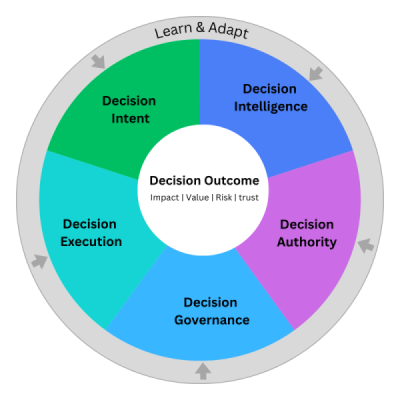
My DnA of Decision-Making Framework has been designed to shift organisations from simply producing insights to intentionally designing how decisions happen. The framework is built around a simple but important principle:Decision Impact. At the centre of the framework are the four outcome dimensions every organisation is ultimately trying to optimise: Impact • Value • Risk…
-
Part 3: The Role of Agentic AI in Decision Intelligence
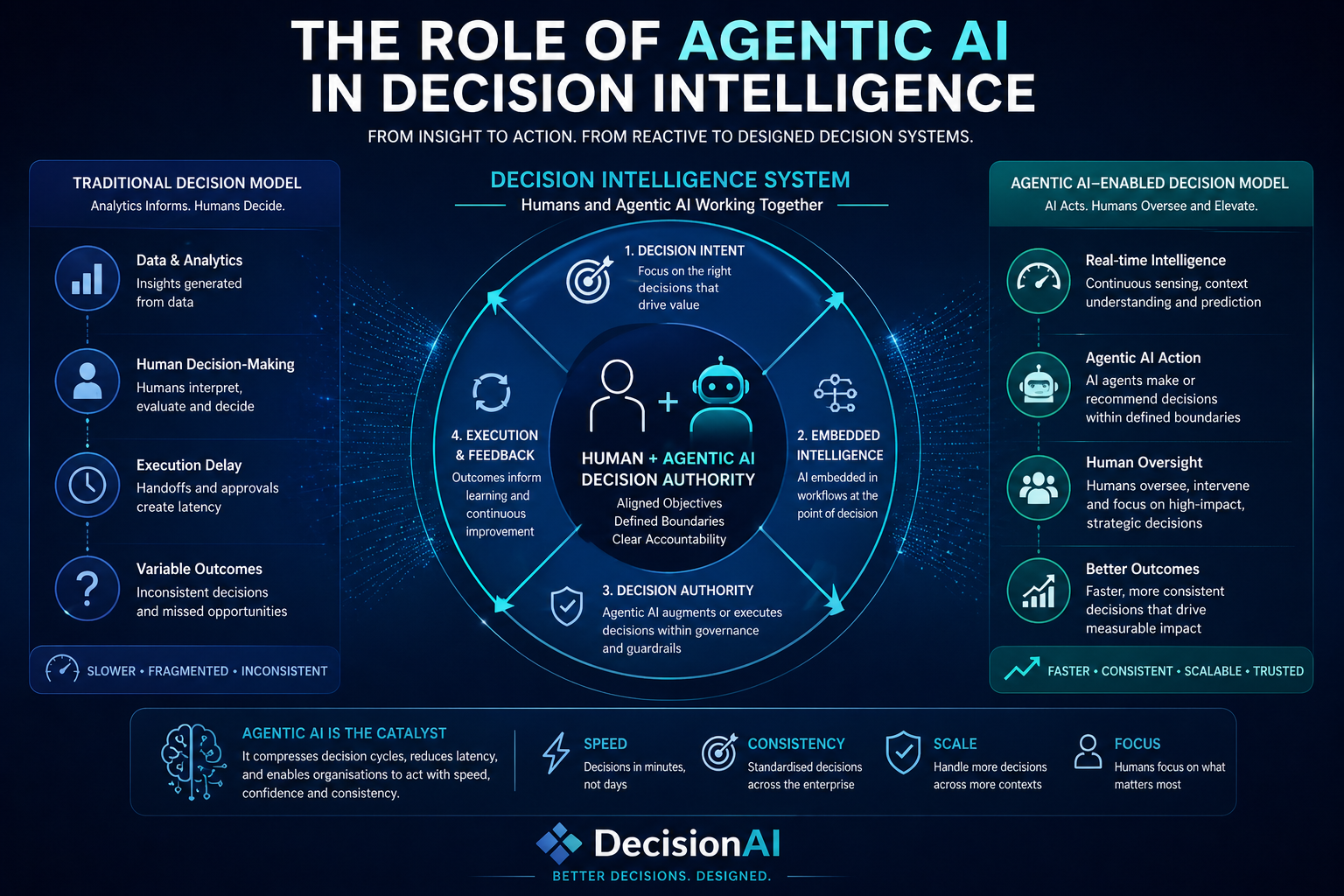
This is Part 3 of a three-part series on Decision Intelligence. In Part 1, I explored why most analytics teams are not set up for Decision Intelligence. In Part 2, I outlined how organisations can redesign for decision-centric systems to close the gap between insight and action. The next question is inevitable: What role does…
-
Part 2: Designing for Decision Intelligence: How to Close the Gap

This is Part 2 of a three-part series on Decision Intelligence. In Part 1, I explored why most analytics teams are not set up for Decision Intelligence and why the gap between insight and action continues to persist in many organisations. The gap is clear. Despite significant investment in data and analytics, many organisations still…
-
Part 1: Why Most Analytics Teams Aren’t Set Up for Decision Intelligence

(This is a three-part series on Decision Intelligence.) After years of sustained investment in data and analytics, most organisations have built mature capabilities: robust data/BI platforms, advanced analytics engines, compelling visualisations, and increasingly advanced models. Yet, despite this progress, many still struggle to make decisions that are consistently better and faster. The challenge is not…
-
The BI → DI Shift: A Maturity Model for Leaders

For more than three decades, organisations have invested heavily in Business Intelligence. Data warehouses, data lakes, lakehouses, dashboards, reporting platforms, and analytics teams have transformed how information is produced and distributed across enterprises. Yet despite unprecedented access to data and powerful analytics technologies, many organisations still struggle with slow, fragmented, and inconsistent decision-making. The reason…
-
The Anatomy of a Decision

Most organisations believe decisions fail because of poor data. They don’t. They fail because the anatomy of the decision is incomplete. We have spent decades optimising Decision Intelligence — dashboards, analytics platforms, AI models, predictive engines. Yet decisions still stall. Escalations linger. Accountability blurs. Execution fragments. The constraint is rarely insight quality. The constraint is…
-
Decision Velocity as a Strategic Capability in the Age of Agentic AI

Despite decades of investment in data, analytics, and business intelligence, many organisations still experience slow and fragmented decision-making. The primary constraint is no longer insight quality, but decision velocity — the ability to move decisions from intent to execution with confidence, authority, and trust. Decision velocity is not a data problem; it is a decision…
-
Shifting from Business Intelligence (BI) to Decision Intelligence (DI)

For a long time, we assumed better dashboards would lead to better decisions. They didn’t. Business Intelligence (BI) gave us visibility. It helped us understand what happened and why. But in many organisations, decision speed didn’t improve — and decision confidence often didn’t either. The constraint was never data. It was decision-making. That’s why I…
-
Decision Support Systems (DSS): from supporting decisions to making them real
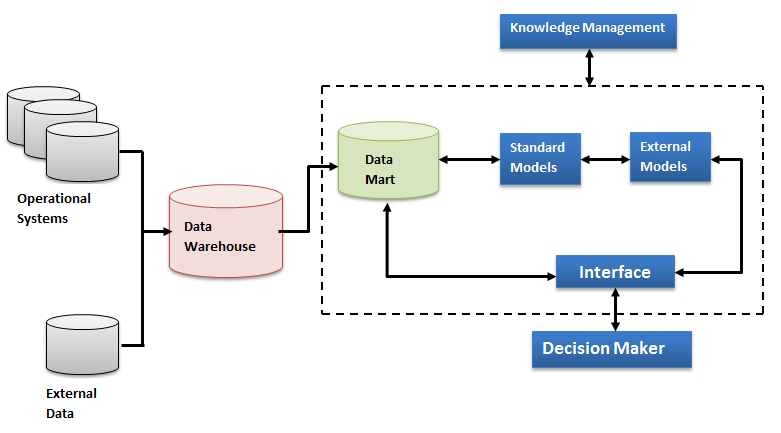
More than 20 years ago, Decision Support Systems (DSS) were the promise.The idea was simple – and ambitious: combine data, models, and interfaces to help organisations make better decisions. On paper, DSS was about decisions. In practice, it quietly became about information. Why classic DSS never lived up to the promise Early DSS assumed a…