
This is Part 3 of a three-part series on Decision Intelligence. In Part 1, I explored why most analytics teams are not set up for Decision Intelligence. In Part 2, I outlined how organisations can redesign for decision-centric systems to close the gap between insight and action.
The next question is inevitable: What role does AI play in this shift? More specifically, what role does Agentic AI play in Decision Intelligence?
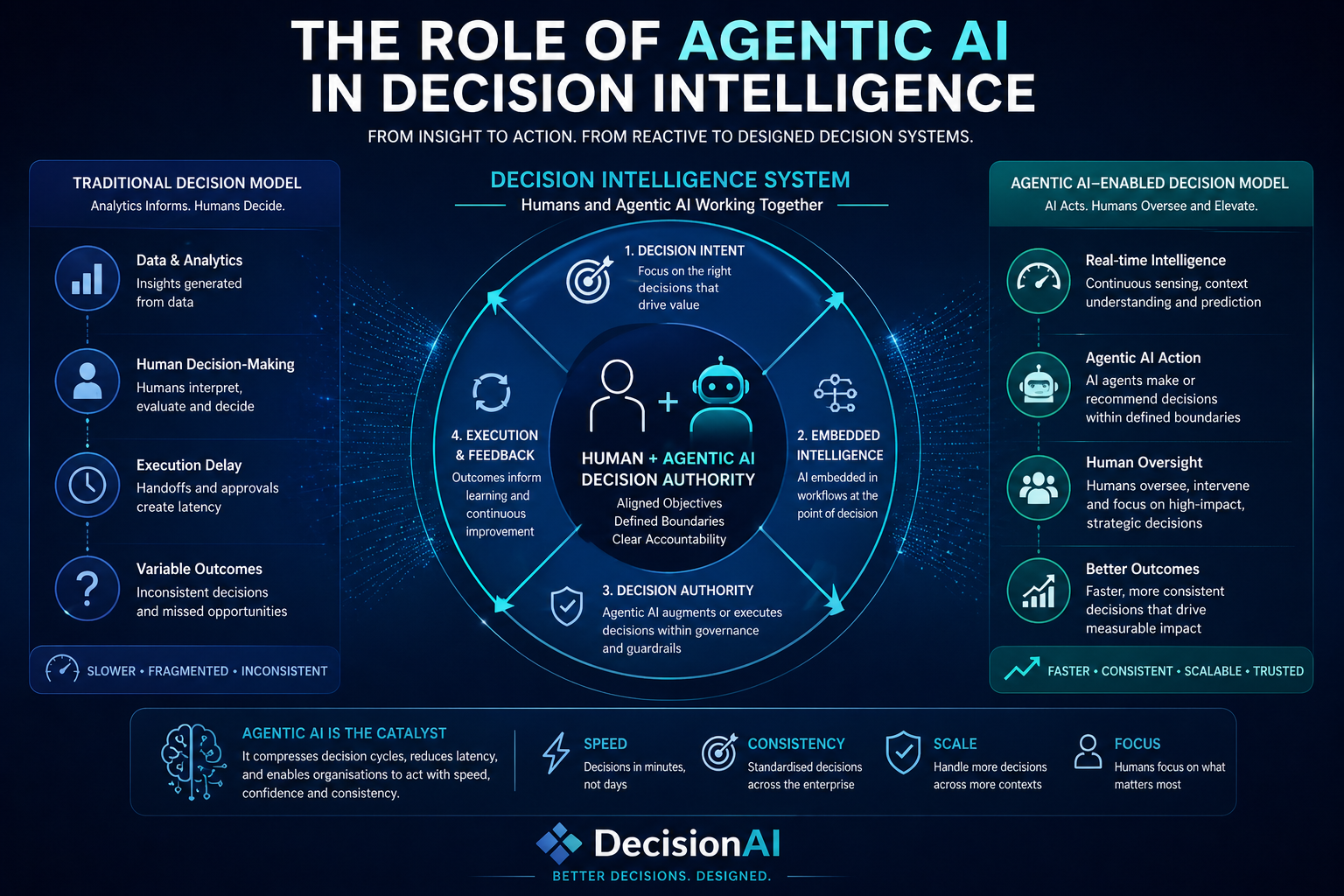
AI has already transformed how organisations generate insights. However, most implementations remain focused on prediction rather than action. Agentic AI introduces a different capability. It enables systems to not only interpret data, but to take actions within defined objectives, constraints, and governance frameworks. This represents a fundamental shift in the decision system.
In traditional models, analytics informs humans, and humans execute decisions. This separation often creates delays, inconsistencies, and dependency on coordination across teams. Research has shown that ineffective decision processes consume a significant portion of managerial time, limiting organisational performance (McKinsey & Company, 2019).
Agentic AI begins to close this gap.
Decisions that are repetitive, high-frequency, or rules-based can be executed in real time by AI agents. More complex decisions can be augmented, with AI surfacing options, evaluating trade-offs, and recommending actions while humans retain authority. Importantly, this is not about removing human decision-makers. It is about designing decision authority more effectively.
Within a Decision Intelligence framework, Agentic AI operates as part of the decision authority layer. It functions under clearly defined governance, with guardrails that ensure alignment to organisational objectives, risk tolerance, and compliance requirements. This is critical, as trust remains one of the primary barriers to AI adoption at scale (IBM, 2023).
The value of Agentic AI emerges when it is integrated into the broader decision system. It must be embedded within workflows, aligned to decision intent, and connected to execution and feedback loops. When this occurs, organisations begin to see measurable improvements in decision speed, consistency, and scalability.
Studies consistently show that reducing delays between insight and action improves organisational performance and reduces the cost of missed opportunities (IBM, 2023). Agentic AI directly addresses this by compressing decision cycles and enabling more responsive operations.
However, this shift also raises important design questions. Which decisions should be automated? Where should human judgment remain central? How should governance frameworks evolve to support AI-enabled decisions? These are not purely technical considerations. They are organisational design and governance challenges. Agentic AI does not eliminate the need for human judgment. It elevates it.
By enabling systems to handle decisions that require speed, scale, and precision, organisations can focus human attention on complex, strategic, and high-impact decisions. The organisations that succeed will not be those that simply adopt AI tools. They will be those that design decision systems where humans and AI work together, under clear authority, governance, and accountability. Because in the end, Decision Intelligence is not about analytics alone, and it is not about AI in isolation. It is about building systems where decisions are faster, better, and trusted. And Agentic AI is the catalyst that makes that possible.
References
McKinsey & Company (2019), Decision Making in the Age of Urgency
IBM (2023), Global AI Adoption Index / The Cost of Delayed Data