
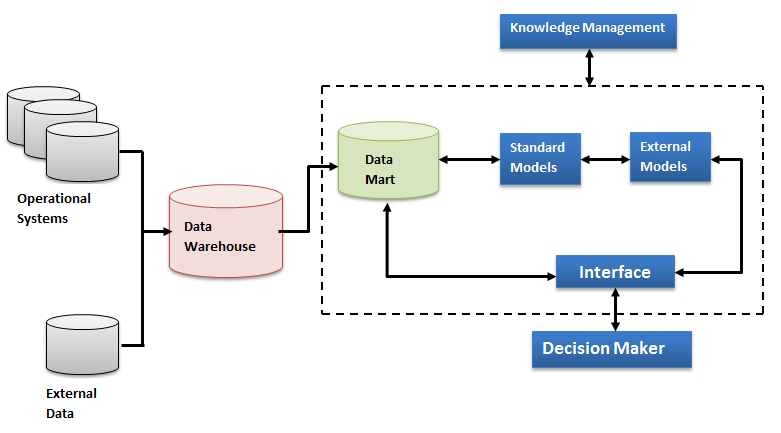
More than 20 years ago, Decision Support Systems (DSS) were the promise.
The idea was simple – and ambitious: combine data, models, and interfaces to help organisations make better decisions.
On paper, DSS was about decisions. In practice, it quietly became about information.
Why classic DSS never lived up to the promise
Early DSS assumed a neat flow:
data → analysis → insight → human decision → action
But that last step – the human decision—was always the weakest link.
What actually happened over the years:
- DSS morphed into data warehouses
- Data warehouses morphed into Business Intelligence
- BI optimised reporting, dashboards, and insight delivery
- And we crossed our fingers that someone, somewhere, would act
This gave us visibility, not decisions.
BI answered:
- What happened?
- What is happening?
- Why might this be happening?
But it rarely answered:
- What should we do?
- Who decides?
- When does the system act?
- What happens if no one acts?
So DSS quietly stalled. Not because the idea was wrong—but because the technology stopped short of execution.
The uncomfortable truth: humans don’t decide the way DSS assumed
Classic DSS assumed humans would:
- read dashboards regularly
- correctly interpret uncertainty
- balance risk and bias
- make timely decisions under pressure
- consistently follow through
Reality check:
- Decisions are delayed
- Insights are ignored
- Bias dominates
- Accountability blurs
- Opportunities pass
So DSS became Decision Awareness Systems, not Decision Support Systems.
Why Agentic AI changes everything
Agentic AI finally closes the loop DSS could never close.
For the first time, systems can:
- understand decision intent
- reason over multiple signals
- operate within delegated authority
- take action (or recommend action)
- learn from outcomes
This is the missing layer DSS never had.
With Agentic AI, DSS becomes:
- decision-centric, not data-centric
- continuous, not episodic
- active, not passive
The flow now looks like this:
decision intent → intelligence → authority → governance → execution → learning
And critically:
- Humans define what matters
- Systems handle what scales
- Governance defines what is allowed
- Accountability is explicit, not assumed
From “supporting” decisions to operating decisions
A modern DSS, powered by Agentic AI:
- doesn’t wait for someone to open a dashboard
- doesn’t rely on hope as a control mechanism
- doesn’t confuse insight with action
Instead, it:
- detects when a decision is required
- determines who or what is authorised to decide
- executes within guardrails
- escalates only when necessary
- learns continuously
This is not about removing humans. It’s about putting humans where they add the most value—and letting systems do the rest.
DSS wasn’t wrong. It was just early.
Decision Support Systems failed to deliver not because the vision was flawed—but because the technology wasn’t ready.
Now it is.
Agentic AI finally allows us to build true Decision Support Systems:
- systems that support decisions by making decisions operable
- systems that respect human judgement without being paralysed by it
- systems that turn intent into action at machine speed, with human trust
After 20+ years, DSS can finally become what it always promised to be.
If BI was about seeing,
Decision Intelligence is about deciding,
and Agentic AI is about doing.
That’s the real evolution.