
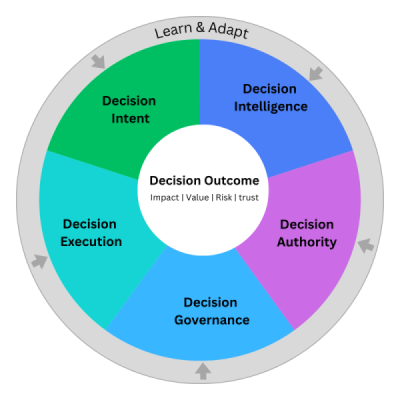
My DnA of Decision-Making Framework has been designed to shift organisations from simply producing insights to intentionally designing how decisions happen.
The framework is built around a simple but important principle:
Decision Impact.
At the centre of the framework are the four outcome dimensions every organisation is ultimately trying to optimise:
Impact • Value • Risk • Trust
Surrounding this core are five interconnected layers that form the “DnA” of effective decision systems:
Decision Intent
Why does this decision exist?
What strategic outcome is being pursued?
Decision Intelligence
What evidence, data, analytics, and context inform the decision?
Decision Authority
Who or what is authorised to decide?
This now explicitly includes AI and agentic systems.
Decision Governance
What policies, controls, escalation pathways, and risk boundaries apply?
Decision Execution
How is the decision operationalised and translated into action?
An outer learning and adapt loop continuously evolves the system over time.
The key insight is this: Many organisations optimise intelligence delivery but neglect decision design itself.
As a result:
• Decisions stall in approval cycles
• Authority is unclear
• Governance becomes reactive
• AI capabilities outpace organisational readiness
• Execution breaks down despite “good insights”
This becomes even more important in the age of Agentic AI. Agentic systems force organisations to answer difficult questions explicitly:
• Which decisions can AI make autonomously?
• What level of risk is acceptable?
• When should escalation occur?
• What authority boundaries exist?
• How is trust maintained at machine speed?
Without intentional decision design, faster AI simply accelerates organisational chaos.
But when intent, intelligence, authority, governance, and execution are deliberately aligned, organisations unlock something much more powerful:
⚡ Decision Velocity
The ability to move from intent to execution with confidence, clarity, trust, and accountability.
That is rapidly becoming a strategic capability.
The question I keep coming back to is this: Are organisations truly designing their decision systems intentionally — or are they simply accelerating existing dysfunction with AI?
Over the coming weeks, I’ll unpack each component of the framework, exploring how they collectively enable faster, more confident, and better-governed decision-making in the age of AI and autonomous systems.
One response to “DnA of Decision Making Framework”
[…] Two weeks ago, I introduced my DnA of Decision-Making Framework. […]