
Most organisations invest heavily in improving intelligence, technology, processes, governance, and increasingly AI. Yet surprisingly little time is spent defining the outcomes that decisions are actually intended to optimise.
Two weeks ago, I introduced my DnA of Decision-Making Framework.
Over the coming weeks, I’ll take a deeper dive into each element of the framework. Rather than starting with data, analytics, governance, or AI, I’m starting at the centre: Decision Outcomes. Because before we discuss how decisions are made, we should first ask a more fundamental question:
What makes a decision a good decision?
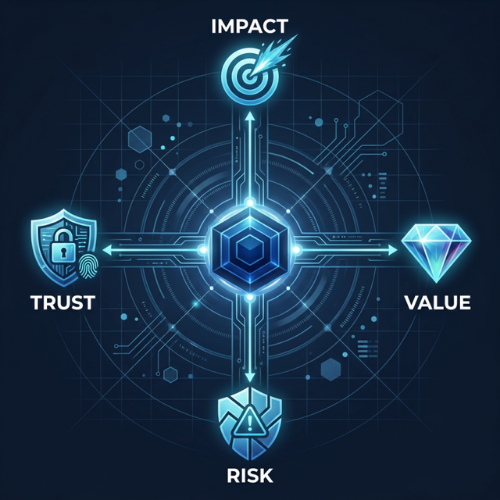
At the heart of the DnA of Decision Making Framework are four outcome dimensions:
Impact: Did the decision achieve the intended outcome? Did it move the organisation closer to its strategic objectives?
Value: Did the decision create measurable benefit? This may be financial, operational, customer, community, or societal value.
Risk: Were risks understood, managed, and kept within acceptable boundaries? Every decision carries risk — the question is whether it is controlled.
Trust: Do stakeholders have confidence in the decision, the process, and the people or systems making it? Trust is often the most fragile and hardest-earned outcome dimension.
The challenge is that these dimensions frequently compete with one another. A decision that maximises value may increase risk. A decision that minimises risk may reduce impact. A decision that creates impact may erode trust if stakeholders do not understand or accept how it was made. This is why decision-making is rarely about optimisation of a single objective. It is about making deliberate and transparent trade-offs across all four dimensions.
One of the principles underpinning the DnA framework is this:
A decision is not successful simply because it is informed, compliant, or executed. It is successful when it achieves the right balance of Impact, Value, Risk, and Trust.
This becomes even more important in the age of Agentic AI. As organisations delegate more decisions to algorithms, copilots, and autonomous agents, we must become increasingly explicit about the outcomes we are trying to optimise. AI can accelerate decisions but only organisations can determine the balance of Impact, Value, Risk, and Trust that defines success.
Before we design decision intelligence, authority, governance, or execution, we should first be clear on the outcomes we are seeking to achieve. Because every decision system ultimately exists for one purpose – to create better outcomes.
Next week, I’ll explore the next element of the framework: Decision Intent — why decisions exist and how clarity of purpose shapes everything that follows.